Leave Your Message
When you start looking at China’s smart thermostat market, you’ll find manufacturers that each have their own thing—some are great at design, others at customization, and plenty offer solid production support. To help buyers compare potential OEM partners, here’s a rundown of ten Chinese companies worth checking out. And don’t let the thermostat itself fool you: it might look like a simple gadget, but little things like where the sensor sits, what wiring options you have, and how the controls feel can make or break everyday use. Yeah, small details really matter.
When you're looking at a candidate, don't just skim the brochure — really dig into the specs, their manufacturing capabilities, quality control, and what technical documentation they actually have on hand. You should also ask about sample testing, firmware updates, communication protocols, and whether they can support local installation needs. But here's the thing: you can't just take their claims at face value. Always double-check directly with the manufacturer, because capabilities can vary depending on the model or even the project. Honestly, it's an easy detail to overlook. When you’re mapping out connected-home products, a supplier’s experience with a Smart Home Lighting System can definitely matter. But here’s the thing: sharing the same connectivity standard doesn’t automatically mean everything will work together seamlessly. So before you commit to a larger order, ask for clear compatibility info and test a few representative devices yourself. This overview is just a jumping-off point—not a substitute for doing your own due diligence on the supplier. Look, company info can change over time, and just because a catalog looks slick doesn't mean the production is actually reliable. You need to find a Smart Thermostat OEM Manufacturer that really fits what you're looking for—check their documented capabilities, how they communicate, and how their products perform. So yeah, do your homework and compare carefully.
Smart thermostat OEM manufacturing in China usually begins with a product brief, not a finished design. The buyer defines heating or cooling equipment, target markets, user controls, and expected production volume. Engineers review the requirements and select suitable sensors, relays, display components, and communication options. Small details matter. A wall plate that looks simple can affect installation, airflow, and temperature readings.
After the design review, the factory may build prototypes and revise the circuit board, enclosure, and firmware. Sample units help check sensor accuracy, button response, screen readability, and compatibility with a Smart House Control System. Engineers also test common operating conditions, such as a room warming gradually or a heating cycle switching off. These checks take time. Early samples are not always representative of mass production, so buyers should ask how design changes are controlled.
Before a production run, the manufacturer typically confirms materials, assembly steps, and inspection criteria. Quality checks can include visual inspection, electrical tests, and verification of temperature readings. Buyers should also clarify software responsibilities, packaging, documentation, and testing records. One weak point is communication: vague requirements can lead to costly revisions. A clear specification helps, but it cannot replace reviewing real samples from the production line.
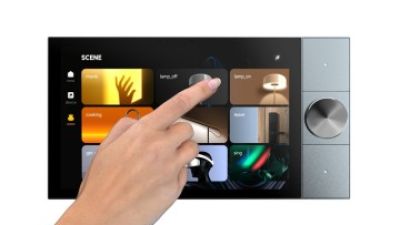
A Smart Home should be simple to use, even when it brings lighting, climate, and entertainment together. This 10-inch control panel combines a touchscreen with a physical knob and button, giving household members different ways to manage everyday settings. A customized one-key function can adjust lights, temperature, and music at once, while the 1280 × 800 IPS display places devices, scenes, and applications in a clear, centralized view. Whether you prefer tapping the screen or making a quick physical adjustment, control feels direct and convenient.
An ambient light sensor automatically adjusts screen brightness to suit the room, and the AIS Life album feature can add a personal touch to the display. Multiple versions support different home setups, including central control, background music, and KNX, with options for wireless and LAN-based intercom control. Connectivity varies by version: the standard interface includes RS485, two-way relays, and L/N wiring; the music version adds AUX and speaker connections; and the KNX version offers KNX, AUX, relays, Type-C, SD card, and Ethernet.
Compare engineering support, production capacity, quality checks, and communication routines. Unit price alone misses important details.
Compare its temperature readings with a trusted thermometer in a stable room. Test relay response and Wi-Fi recovery after restarting the router. Simple, but useful.
Ask for wiring diagrams, compatibility tables, test procedures, sample reports, and inspection records. Confirm each document matches the exact model.
Ask how the factory calibrates sensors and records results. A workbench calibration setup can be informative, but records matter too.
Check wiring terminals, power requirements, control logic, and supported heating or HVAC systems. A thermostat can fit a wall box yet lack the right terminals.
Agree on who handles revisions and how changes are documented. Ask whether interface adjustments affect cost or delivery time. Easy to overlook.
Confirm minimum order quantities, lead times, spare parts, warranty handling, and engineering support. Compare the sample with the production specification.
No. Review inspection records and ask how defects are documented and corrected. A polished visit can still leave questions. I would keep checking samples.
This guide explains how smart thermostat OEM manufacturing works in China, from product planning and engineering to prototyping, production, and quality control. It also outlines the technologies and features buyers may encounter, including temperature sensing, connectivity, scheduling, energy monitoring, and compatibility with different heating and cooling systems. Understanding these elements can help businesses define product requirements and communicate more effectively with potential manufacturing partners.
The article introduces ten leading Chinese manufacturers without focusing on brand promotion, then compares their product ranges, technical capabilities, customization options, production capacity, and support services. It also presents practical criteria for evaluating a Smart Thermostat OEM Manufacturer and steps for verifying a prospective partner, such as reviewing samples, checking quality processes, confirming development capabilities, and clarifying communication and after-sales arrangements. Together, these insights offer a structured way to assess options and select an OEM partner suited to a project’s needs.